A beautiful label that skips a required element is still a non-compliant label, and for cosmetics the requirements are specific enough that brands trip over them all the time. Before you approve artwork for a skincare or beauty product sold in the United States, it helps to know exactly what has to appear, where it goes, and how small the type is allowed to be. This is a plain-English walkthrough of what federal rules ask for, plus what the Modernization of Cosmetics Regulation Act, known as MoCRA, has added.
The two panels every cosmetic label is built around
Federal labeling divides your container into two working areas. The principal display panel is the face a shopper sees first on the shelf. It has to carry a statement of identity, meaning the product name together with a description or illustration of what the product is, so a jar reads clearly as, say, a facial moisturizer rather than just a brand word. The principal display panel also carries the net quantity of contents. Everything else, including the ingredient list and the company’s contact details, can live on the information panel, which is any panel immediately to the right of the principal display panel or another surface designed for that copy. Getting this split right early prevents the common mistake of crowding required legal copy onto the front where it fights your branding.
Net quantity, identity, and the business address
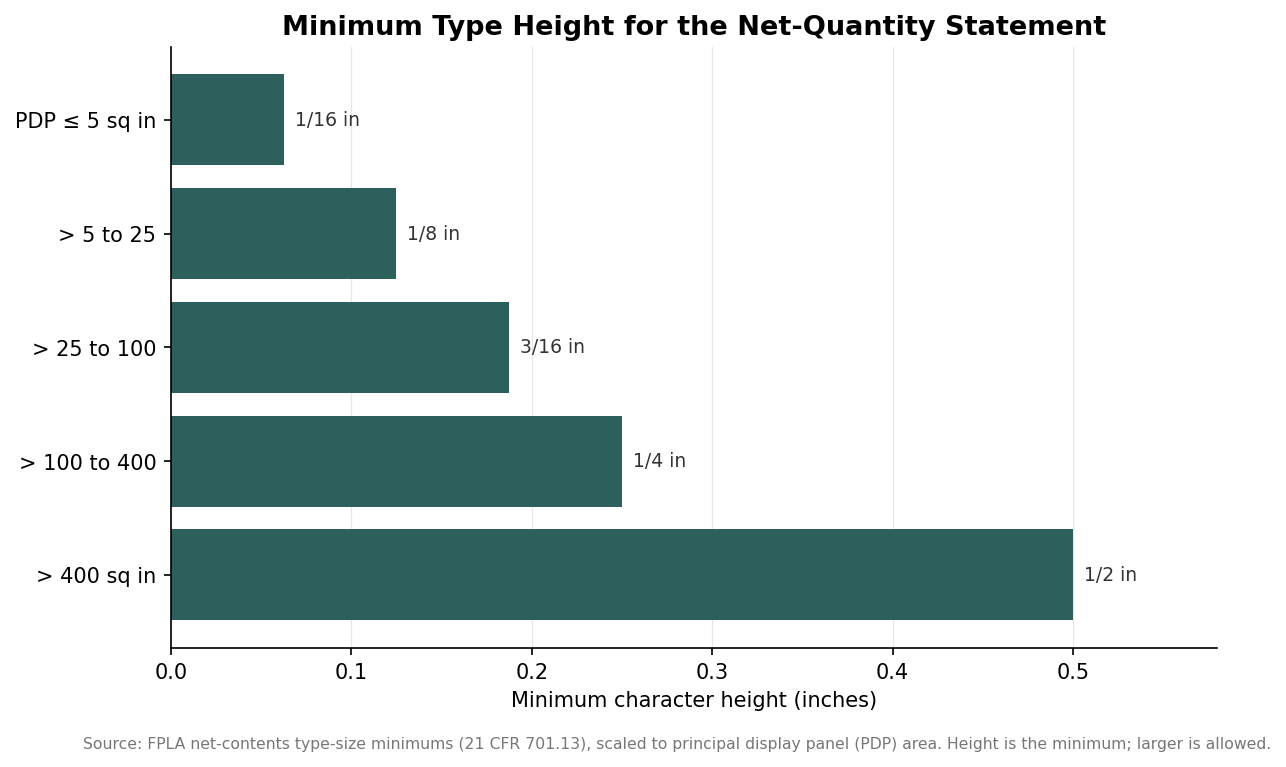
The net quantity statement has real formatting rules. It belongs in the bottom area of the panel, set on a line generally parallel to the base the package rests on, and its type has to be sized to the panel. For solids and semisolids you use avoirdupois pounds and ounces; for liquids you use fluid ounces, pints, quarts, or gallons; and once a package holds at least a pound or a pint you express the larger measure in parentheses, as in sixteen ounces followed by one pound in parentheses. You may add metric units alongside. The minimum character height scales with the size of the principal display panel, which the chart below lays out.
On the information panel you need the name and place of business of the firm marketing the product, including a street address, city, state, and ZIP code. The street address can be dropped only if the firm is listed in a current phone or business directory. If the company selling the product did not make it, which is true for most small brands using a contract manufacturer, the address has to be qualified with a phrase like “Manufactured for” or “Distributed by.” Products of foreign origin also need a country-of-origin statement.
The ingredient list: order, INCI, and fragrance
Ingredients are declared in descending order of predominance, so the component you use most is listed first and the trace ingredients come last. There is a practical exception: color additives and any ingredients present at one percent or less do not have to follow strict order, which is why you often see colors grouped at the end. Names must follow the recognized nomenclature, in practice the INCI system, so “water” appears as aqua and botanical extracts appear under their standardized Latin-plus-common naming. Fragrance and flavor can be declared simply as fragrance or flavor rather than broken into constituents, and genuinely proprietary components can be grouped as “and other ingredients” after the disclosed ones. Type size matters here too: the ingredient declaration must be at least one-sixteenth of an inch tall, dropping to one thirty-second of an inch only on very small packages whose total surface is under twelve square inches.
When your “cosmetic” is actually a drug
This is the distinction that catches skincare brands most often. The moment a product makes a therapeutic claim or contains an active that changes the body’s structure or function, it is regulated as an over-the-counter drug in addition to being a cosmetic. Sunscreen, anti-acne treatments, antiperspirants, anti-dandruff shampoo, and anything promising to treat a condition all fall here. Those products need a Drug Facts panel and must list active ingredients first, ahead of the cosmetic ingredients, along with the drug’s uses, warnings, and directions. If your moisturizer advertises an SPF, you are labeling a drug, not just a cosmetic, and the artwork requirements expand accordingly. When a product’s safety has not been substantiated, federal rules even prescribe a specific warning that the safety of the product has not been determined.
What MoCRA added, and what is still coming
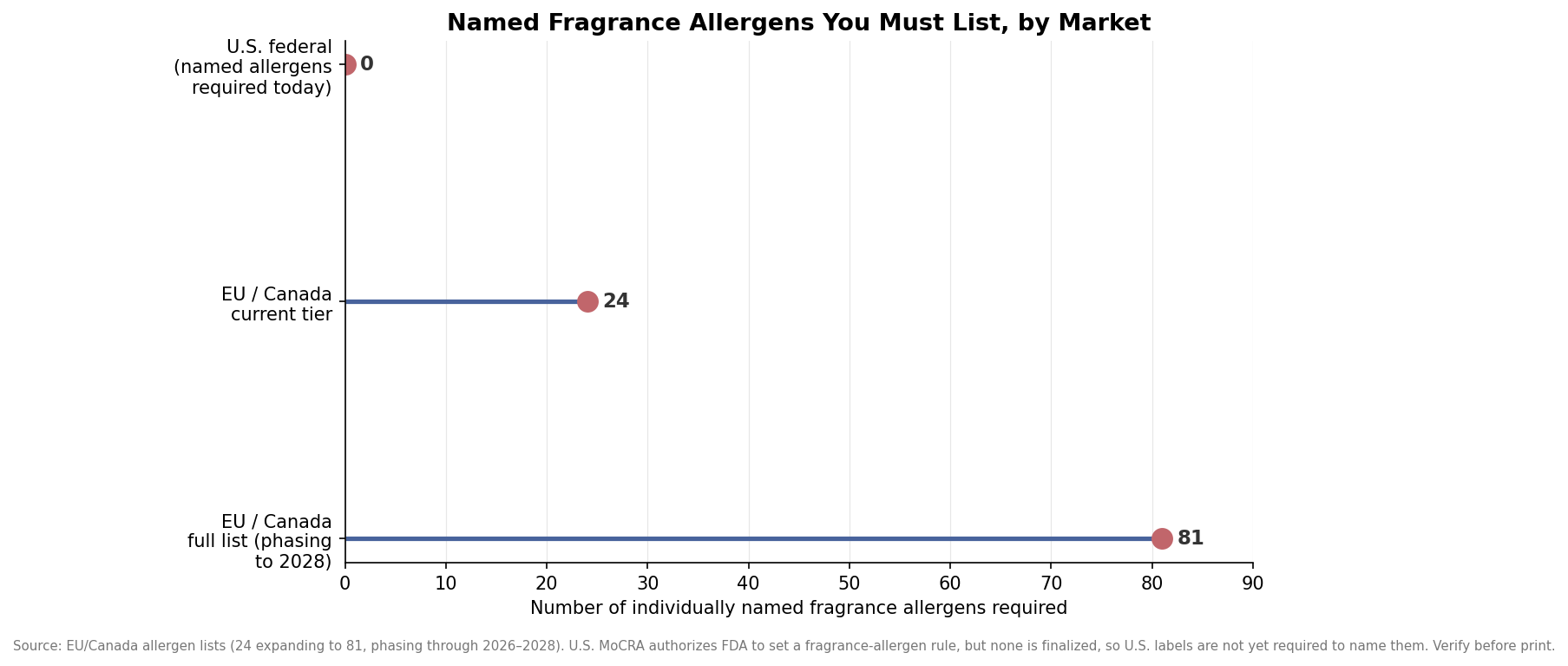
MoCRA layered new obligations on top of the long-standing rules. The label-facing one to plan for is a requirement to provide contact information through which the responsible person can receive adverse event reports, which in practice means a domestic address, a domestic phone number, or an electronic contact tied to the party accountable for the product. Products meant only for licensed professionals should also carry a clear professional-use statement while still meeting all the consumer requirements above. The change many brands ask about, individually naming fragrance allergens on the label, is authorized under MoCRA but has not yet been finalized as a binding federal rule, so United States labels are not currently required to list them. That is very different from the European Union and Canada, which already require named allergen disclosure and are expanding those lists, as the second chart shows. If you sell internationally, design your ingredient copy with that trajectory in mind rather than reprinting later.
Two takeaways make the whole thing manageable. First, lay out the required elements before the visual design, not after, so legal copy has a home and a legible type size instead of being squeezed in at the proof stage. Second, decide honestly whether your claims push the product into drug territory, because that single question changes the entire panel structure. This overview covers the common cases, but requirements change and edge cases exist, so confirm the current FDA guidance or run your final artwork past a regulatory specialist before you commit a print run.
Leave a Reply